According the The Register (UK), Spammers have developed an "mailbot" that can break through Google's CAPTCHA (Completely Automated Public Turing test to tell Computers and Humans Apart) system. That's Google's version of the thing that makes you read distorted characters to sign up for email and other online services, including some online banking services.
It won't be long before a robot will be able defeat any current Captcha system, so those with such systems deployed should make sure they A) are using multi-factor schemes for securely adding and identifying their users and B) have the latest versions of the Captcha program installed.
Since the robots are currently successful against Google only 20% of the time, there is still some time for software developers and users to stay ahead by improving Captcha and combining it with other techniques for telling humans from programs. For instance, several Captcha images could be displayed, and the user asked to identify which of them are alike, or which of them match a given pattern (also displayed via Captcha).
Tuesday, February 26, 2008


Tuesday, December 11, 2007
How to win on Deal or No Deal
[Originally blogged 2006-03-26, updated 2007-12-11 (see below)]
NBC's vapid, but fun, game show Deal or No Deal seems simple enough. I doubt it will be the next Wheel of Fortune, or even the next Weakest Link, but stranger things have happened.
The contestant picks a suitcase out of 26 held up by scantily clad models. A board shows amounts, from 1 penny up to ONE MILLION DOLLARS (-oooh-). The contestant gets to pick some more, revealing the amounts held in them -- will it be ONE MILLION DOLLARS (-oooh-)? The contestant is given the choice to keep the suitcase he has, and win its contents, or go on picking others.
How to decide?
The answer is with expected value, a principle of mathematics that sounds fancy but in this case requires only simple arithmetic.
Expected value normally means finding the sum of all possible outcomes multiplied by their individual probability. It can get unwieldy, but in this simple case the odds of the outcomes are all the same, 1/N, where N is the number of values left on the board.
At any given step, add the total amount left on the board, and divide by the number of entries left. Since each amount left has equal chance of being in any of the suitcases, including your own, the expected value for a given suitcase is just the average.
When the banker calls, if your expected value if you remain in the game is higher than his offer, reject it. If his offer is higher or the same as the expected value, take it.
For instance, suppose you have entries on the board (three suitcases and your own). The amounts are $100,000, $50,000, $10, and $.01. The penny looks scary, but the $100k looks tempting. What to do?
The total is $150,010.01, which you round to $150k for an average of about $37,500. If the banker calls with an offer: $35,000, you should reject the offer. If the offer is $38,000, take it.
The reason this is the best strategy is that if you played the game many, many times, on average you'd win the expected value of what's left.
[Update: After watching this show off and on for a few months, I realized two things. First, the show did become the next Weakest Link. Secondly, simply math wasn't enough to provide a winning strategy, and in fact isn't really needed.
To win, you have to define "winning". There are two kinds of winning: winning lottery-big (a life-altering amount), and walking out with a respectable prize, one that will solve some immediate problems for you: let you open a business, buy/pay off the house, take a less stressful job, whatever.
So that gives us three kinds of numbers the cases can hold:
Think about the end game: you have some small prizes and two big ones, $100,000 and $400,000. If you open a case with a small number, your offer will go up; keep going. Even if you open the $100,000 case, your offer will still not go down that much, and you can accept it with glee. Only if you choose the highest of the lottery amounts will your offer go down significantly, and you walk away with a nice paycheck.
If you reject the offer when you have only one lottery prize left, you risk coming away with nothing when you have a very easy way (at that point) to solve some problems for yourself. If you only have one big amount left on the board, make the Deal.
]
NBC's vapid, but fun, game show Deal or No Deal seems simple enough. I doubt it will be the next Wheel of Fortune, or even the next Weakest Link, but stranger things have happened.
The contestant picks a suitcase out of 26 held up by scantily clad models. A board shows amounts, from 1 penny up to ONE MILLION DOLLARS (-oooh-). The contestant gets to pick some more, revealing the amounts held in them -- will it be ONE MILLION DOLLARS (-oooh-)? The contestant is given the choice to keep the suitcase he has, and win its contents, or go on picking others.
How to decide?
The answer is with expected value, a principle of mathematics that sounds fancy but in this case requires only simple arithmetic.
Expected value normally means finding the sum of all possible outcomes multiplied by their individual probability. It can get unwieldy, but in this simple case the odds of the outcomes are all the same, 1/N, where N is the number of values left on the board.
At any given step, add the total amount left on the board, and divide by the number of entries left. Since each amount left has equal chance of being in any of the suitcases, including your own, the expected value for a given suitcase is just the average.
When the banker calls, if your expected value if you remain in the game is higher than his offer, reject it. If his offer is higher or the same as the expected value, take it.
For instance, suppose you have entries on the board (three suitcases and your own). The amounts are $100,000, $50,000, $10, and $.01. The penny looks scary, but the $100k looks tempting. What to do?
The total is $150,010.01, which you round to $150k for an average of about $37,500. If the banker calls with an offer: $35,000, you should reject the offer. If the offer is $38,000, take it.
The reason this is the best strategy is that if you played the game many, many times, on average you'd win the expected value of what's left.
[Update: After watching this show off and on for a few months, I realized two things. First, the show did become the next Weakest Link. Secondly, simply math wasn't enough to provide a winning strategy, and in fact isn't really needed.
To win, you have to define "winning". There are two kinds of winning: winning lottery-big (a life-altering amount), and walking out with a respectable prize, one that will solve some immediate problems for you: let you open a business, buy/pay off the house, take a less stressful job, whatever.
So that gives us three kinds of numbers the cases can hold:
- Small: lower than your "respectable" win
- Respectable: At or higher than your "respectable" expectation
- Lottery: A number big enough to make your offer close to respectable.
Think about the end game: you have some small prizes and two big ones, $100,000 and $400,000. If you open a case with a small number, your offer will go up; keep going. Even if you open the $100,000 case, your offer will still not go down that much, and you can accept it with glee. Only if you choose the highest of the lottery amounts will your offer go down significantly, and you walk away with a nice paycheck.
If you reject the offer when you have only one lottery prize left, you risk coming away with nothing when you have a very easy way (at that point) to solve some problems for yourself. If you only have one big amount left on the board, make the Deal.
]
Wednesday, October 24, 2007
Exceed, Cygwin, and Terminal Server
... or "How to waste an afternoon"
I've been having trouble getting the combination of MS Terminal Server 2003, Hummingbird Exceed 2006, and Cygwin to work together.
Cygwin's Xfree86 doesn't work well for Terminal Server, since Cygwin's X has one global X.log file that is owned by and read-only for only one user at a time. So we use Hummingbird Exceed on the Terminal Server.
But Exceed doesn't come with xterm, ssh, etc. They expect you to use rsh, rexec, or a program you configure with their proprietary goo to connect to your remote systems. Not my style.
Background
X programs running on a remote host can display on your computer through the use of a lot of complicated technology, much of which depends on a properly set environment variable named DISPLAY. It's format is
DISPLAY=your.hostname:N.m
where "your.hostname" is either the domain name your ISP gives you, an IP address, or the special name "localhost". All computers on the Internet believe that they themselves are "localhost".
Ssh programs (either the proprietary ones from SSh, Inc., or free versions such as openssh or putty) have a wonderful feature: they can hijack data to be sent to your local computer, encrypt it, send it over their secure connection, and deliver it to your local computer for display. They do this by setting the remote DISPLAY variable to (for example) "localhost:10.0". Remote programs you run send their output to remote display 10, screen 0. Ssh receives the data, encrypts, delivers, decrypts, and sends to whatever your local DISPLAY variable says.
But I've not been able to find a Windows-based Ssh program that is able to tunnel X11 connections with remote hosts to Exceed. In the past, I've just looked at the display number in the Exceed taskbar button and set DISPLAY manually, losing the benefits of tunneling.
A little digging turned up some documentation (pdf), which says:
In /etc/profile on your Terminal Server, put the following:
[Updated 20071026 to touch the script a bit]
I've been having trouble getting the combination of MS Terminal Server 2003, Hummingbird Exceed 2006, and Cygwin to work together.
Cygwin's Xfree86 doesn't work well for Terminal Server, since Cygwin's X has one global X.log file that is owned by and read-only for only one user at a time. So we use Hummingbird Exceed on the Terminal Server.
But Exceed doesn't come with xterm, ssh, etc. They expect you to use rsh, rexec, or a program you configure with their proprietary goo to connect to your remote systems. Not my style.
Background
X programs running on a remote host can display on your computer through the use of a lot of complicated technology, much of which depends on a properly set environment variable named DISPLAY. It's format is
DISPLAY=your.hostname:N.m
where "your.hostname" is either the domain name your ISP gives you, an IP address, or the special name "localhost". All computers on the Internet believe that they themselves are "localhost".
Ssh programs (either the proprietary ones from SSh, Inc., or free versions such as openssh or putty) have a wonderful feature: they can hijack data to be sent to your local computer, encrypt it, send it over their secure connection, and deliver it to your local computer for display. They do this by setting the remote DISPLAY variable to (for example) "localhost:10.0". Remote programs you run send their output to remote display 10, screen 0. Ssh receives the data, encrypts, delivers, decrypts, and sends to whatever your local DISPLAY variable says.
But I've not been able to find a Windows-based Ssh program that is able to tunnel X11 connections with remote hosts to Exceed. In the past, I've just looked at the display number in the Exceed taskbar button and set DISPLAY manually, losing the benefits of tunneling.
A little digging turned up some documentation (pdf), which says:
Ok, now I know what to do. I can grab the DISPLAY number from that file, which by the grace of Hummingbird is a text file and not more proprietary goo. Unfortunately, it's a Windows file, with an ugly filename with spaces in it. So I need a script to turn that into a Cygwin name:
While Exceed sessions are running, the display numbers are tracked through a dynamic file called Display Snapshot.HumTable. This is located in
C:\Documents and Settings\All Users\Application Data\Hummingbird\Connectivity\11.00\Global\Exceed\Display Snapshot.HumTable
As this is dynamic, it should not be edited manually.
In /etc/profile on your Terminal Server, put the following:
HUMTABLE="C:\Documents and Settings\All Users\Application \
\Data\Hummingbird\Connectivity\11.00\Global\Exceed\Display Snapshot.HumTable"

#
# sanify - turn a Windows directory name into a Unix name
#  - turns drive letters into /cygdrive/drive,
#  - flips slashes, removes enclosing quotes,
#  - replaces unusual characters with '?'
function sanify() {
     echo ${@} | sed \
             -e 's,^[A-Za-z]:,/cygdrive/&,'\
             -e 's,:,,g' \
             -e 's,\\,/,g' \
             -e 's,^\",,g' \
             -e 's,\"$,,g' \
             -e 's,[^A-Za-z0-9_\.-],\?,g'
     }
# disp() grabs the information from the Humtable file
# and puts it in the right format.

DOMAIN=your_windows_domain

function disp() {
    EX_LF="`sanify ${HUMTABLE}`"
    [ -r $EX_LF ] && {
          cat $EX_LF | awk -v d=$DOMAIN u=${USERNAME} \
             'BEGIN {FS=","}\
              $3 ~ d "." u {print "localhost:" $4 ".0";}'
            }
    }
export DISPLAY=`disp`
[Updated 20071026 to touch the script a bit]
Thursday, October 04, 2007

Tuesday, September 25, 2007
Script for OpenSSL Certificate Signing Request
[Updated for bugfix 20080722] If you're like me, you need a new SSL Certificate about once a year. You know what to do:
I always have to look up the right openssl(1) command line arguments.
This year, I decided to make a script. This script takes an optional argument, the host for which you're making the certificate. I suggest generating the Certificate on the target host, but if you feel bold you can make a CSR for any host you want.
- Generate a "Certificate Signing Request" and a key
- Send the CSR to your Certificate Authority for signing
- Wait for the signed Certificate to come back from the CA
- Put the key and the Certificate where your web, email, or other server can find them
I always have to look up the right openssl(1) command line arguments.
This year, I decided to make a script. This script takes an optional argument, the host for which you're making the certificate. I suggest generating the Certificate on the target host, but if you feel bold you can make a CSR for any host you want.
#!/bin/sh
#
#############################
#
# Shell script to automate making
# Certificate Signing Requests (CSR)
# with openssl
#
# tested on v 0.9.8e
# Loren Heal
#
#############################

echodo() {
     echo "${@}"
     (${@})
     }

yearmon() {
     date '+%Y%m%d'
     }

fqdn() {
     (nslookup ${1} 2>&1 || echo Name ${1}) \
             | tail -3 | grep Name| sed -e 's,.*e:[ \t]*,,'
     }


C=Your_Country_Abbreviation
ST=Your_State_Spelled_Out
L=Your_City
O="Your Company or Whatever"
OU="Your Office or Department or Whatever"
HOST=${1:-`hostname`}
DATE=`yearmon`
CN=`fqdn $HOST`

csr="${HOST}-${DATE}-csr.pem"
key="${HOST}-${DATE}-key.pem"

openssl req -new -newkey rsa:1024 -keyout $key \
     -nodes -out $csr <<EOF
${C}
${ST}
${L}
${O}
${OU}
${CN}
$USER@${CN}
.
.
EOF
echo ""

[ -f ${csr} ] && echodo openssl req -text -noout -in ${csr}
echo ""
Thursday, September 20, 2007
Why not to buy an LCD TV
When the Microvision Pico Projector technology spreads and stabilizes, you won't need a screen, just a white wall.
Though I'm told they do it all with mirrors.
Tuesday, September 18, 2007
Paperless Voting Logic Errors
The Information Technology & Innovation Institute has published their report (pdf) on electronic voting, and as advertised in their press release last week, they think a paper trail is unneeded and even harmful. To this end their report employs a series of logical fallacies, hinting that their research began with a premise and attempted to validate it, rather than simply seeking the facts.
The biggest mistake the report makes is a result of the incorrect assumption that all-electronic voting is a worthwhile goal. It fails to think outside the box created by that assumption, which would have revealed a better solution.
The report begins
The fallacies fly beginning with the opening three words: "Americans trust computers" relies on an Appeal to Popularity, and Ambiguity in the words "trust" and "computers". A report intending to provide technical background and subject-matter expertise should not rely on public opinion for its primary argument. That Americans believe a certain thing does not make it true, unless we are talking about the definition of words or something else which is made true by popular acceptance. While "trust" has a variety of meanings to politicians, it has a more specific meaning in the field of computer security and information assurance. That something is trusted means only that its level of insecurity is acceptable, not that it is perfect. And the computers and most importantly the ways they are connected in banking, medicine, and aviation are markedly different than voting machines.
So the report begins by asserting that the paper trail debate is only about trusting computers, even unleashing against those who want a paper trail the ad hominem "technophobic", when in fact there is far more to it than trusting computers. It is about designing a process that doesn't require trusting computers. Many of us seeing the need for a paper trail are among the least technophobic people there are, knowing exactly when to trust a computer and when not to do so.
Most of the report sets up paper-only ballots as a sinister straw man, bringing up the history of paper ballots (e.g., with the sidebar: "How LBJ Stole and Election with Paper Ballots") and insisting that anyone opposed to direct-record electronic (DRE) voting machines must be for that kind of corruption and inefficiency.
Despite the imprecise terminology (misusing the word "vote" for "ballot"), the electronic "guarantees" provided to the voter are not worth the paper they aren't printed on. The guarantees all require trusting the system, which is exactly what we are trying to establish. This is known as "begging the question".
The report goes even further, however, and makes a misstatement of fact, saying "The third property, that the vote was tallied as recorded, is not provided by voter-verified paper audit trails." In fact it is precisely this property which a paper trail provides.
An machine which prints the official ballot and sends an electronic copy to a central location can be far more secure and trustworthy than an all-electronic one. If each voter, or a statistically important sample of them, inspects his paper ballot, then the tally of the paper ballots had better match the electronic one. The reason is this: the ballot box could be compromised, and the electronic data could be compromised, but the task of compromising them both in the same way is exceedingly difficult, equivalent to compromising everyone and everything involved. DRE systems as recommended by this report are incapable of that level of assurance.
All-electronic voting can never be as secure, and especially not as robust, possibly even as paper-only but especially not a hybrid of both. This report may have concluded that if it had not begun with its conclusion already fixed in place.
The biggest mistake the report makes is a result of the incorrect assumption that all-electronic voting is a worthwhile goal. It fails to think outside the box created by that assumption, which would have revealed a better solution.
The report begins
Americans trust computers to run critical applications in fields such as banking, medicine, and aviation, but a growing technophobic movement believes that no computer can be trusted for electronic voting.The report could have ended with its conclusion that a computer could be trusted for electronic voting, and saved us all the trouble, but unfortunately it did not.
The fallacies fly beginning with the opening three words: "Americans trust computers" relies on an Appeal to Popularity, and Ambiguity in the words "trust" and "computers". A report intending to provide technical background and subject-matter expertise should not rely on public opinion for its primary argument. That Americans believe a certain thing does not make it true, unless we are talking about the definition of words or something else which is made true by popular acceptance. While "trust" has a variety of meanings to politicians, it has a more specific meaning in the field of computer security and information assurance. That something is trusted means only that its level of insecurity is acceptable, not that it is perfect. And the computers and most importantly the ways they are connected in banking, medicine, and aviation are markedly different than voting machines.
So the report begins by asserting that the paper trail debate is only about trusting computers, even unleashing against those who want a paper trail the ad hominem "technophobic", when in fact there is far more to it than trusting computers. It is about designing a process that doesn't require trusting computers. Many of us seeing the need for a paper trail are among the least technophobic people there are, knowing exactly when to trust a computer and when not to do so.
Most of the report sets up paper-only ballots as a sinister straw man, bringing up the history of paper ballots (e.g., with the sidebar: "How LBJ Stole and Election with Paper Ballots") and insisting that anyone opposed to direct-record electronic (DRE) voting machines must be for that kind of corruption and inefficiency.
Unfortunately, paper-based auditing trails such as these do not allow the voter to verify that the results of an election are accurate. A DRE voting machine can provide up to three different guarantees to a voter: first, that the vote was cast as intended; second, that the vote was recorded as cast; and third, that the vote was tallied as recorded.
Despite the imprecise terminology (misusing the word "vote" for "ballot"), the electronic "guarantees" provided to the voter are not worth the paper they aren't printed on. The guarantees all require trusting the system, which is exactly what we are trying to establish. This is known as "begging the question".
The report goes even further, however, and makes a misstatement of fact, saying "The third property, that the vote was tallied as recorded, is not provided by voter-verified paper audit trails." In fact it is precisely this property which a paper trail provides.
An machine which prints the official ballot and sends an electronic copy to a central location can be far more secure and trustworthy than an all-electronic one. If each voter, or a statistically important sample of them, inspects his paper ballot, then the tally of the paper ballots had better match the electronic one. The reason is this: the ballot box could be compromised, and the electronic data could be compromised, but the task of compromising them both in the same way is exceedingly difficult, equivalent to compromising everyone and everything involved. DRE systems as recommended by this report are incapable of that level of assurance.
All-electronic voting can never be as secure, and especially not as robust, possibly even as paper-only but especially not a hybrid of both. This report may have concluded that if it had not begun with its conclusion already fixed in place.
Friday, September 14, 2007
Poisoning the Well on Electronic Voting
A "think tank" called the Information Technology and Innovation Foundation is due to release a report on Tuesday, September 18, with the counterintuitive conclusion that a paper trail does not add to the security of electronic voting systems. They're holding a briefing, at which the following will explain their conclusion:
Rep. Vernon Ehlers (R-MI)
Robert Atkinson, President of ITIF
Daniel Castro, Senior Analyst with ITIF
They've got a heavy burden of proof to lift, since it's apparent to anyone who thinks about this subject that an all-electronic system can never be trusted.
They also have to show that they were not funded, commissioned, or beholden to someone with a motivation for making electronic voting paperless. Rep. Ehlers fails that burden immediately, because as a sitting member of Congress his insight into secure electronic voting is suspect.
They may say a paper trail doesn't in itself add security, which only applies if the paper trail is done poorly.
With the long development and approval cycle of election systems, there is a gaping hole in any all-electronic system: fault exploits are developed quickly, while the systems have great inertia. An unfixable design flaw may be widely known on election day, and yet the vulneralble system will be deployed because that's how the government works.
I'll have more when they release the report.
Wednesday, August 22, 2007
Programs I Want to Write
A Shell script compiler
A To Do / Project manager
A better (robust, complete, elegant) compiler language
A March Madness tournament picker
A GUI for script writing
Monday, August 06, 2007
Keeping Safe Online
(Reposted by permission from Slashdot)
There is a tendency to want the government to do something about every problem, and the hassle of online scumbaggery is no exception. Individuals (and their guardians) need to take responsibility for their own protection, and not expect either the government to protect them (which it cannot) or for faceless strangers to be kind to them, which a tiny but significant portion will not.
Each of these steps solves roughly half of the remaining problems not solved by the previous ones.
- A fool and his unarchived data are soon parted. If you want it, make an offline copy of it.
- Switch to Linux, a Mac, or Anything But Windows. Most of the following only apply if this one won't work for you.
- Switch to Mozilla Firefox.
- Buy and install a firewall box. These are very easy to set up, and will save you a ton of trouble.
- Buy and install a virus scanner.
- Download and install Lavasoft Ad-Aware or similar spyware detector, even if your virus scanner says it provides that protection.
- Don't open email with attachments you aren't expecting, or respond to spam with so much as a single click. You have been warned.
- Stay away from porn sites. They're bad for your computer.
- Stay away from online games except those you know to be crap-free.
- You don't know that any of them are crap-free.
- Don't download commercial music except from commercial vendors to whom you pay a fee. Yeah, sucks to be us. But you get what you deserve, and if you're trying to get something for nothing, you'll give something for nothing in return.
So what do you do if your kids download some game, P2P app, or other crapware-laden piece of stupidity? Take away the computer. What if you have several kids, and you don't know who did it? Enlist their aid and hold them all accountable. Tell them that if any of them downloads crapware and the guilty party won't come forward, they all do their homework at the library (for a week or month or whatever).
Saturday, August 04, 2007
A.Rod's Big Day

"The Yankees' Alex Rodriguez became the youngest player to reach 500 home runs on Saturday."
Now, I know it's not really ambiguous, since hitting 500 home runs over the course of a career is still fairly rare.
Just saying.
Oh, and congrats Alex. Maybe now you can get a decent contract and start making some real money.
Friday, August 03, 2007
Making Strings Out of Numbers in C
A while back I was writing a C program and found I needed to convert numbers (integers) into strings. The language has no built-in facility for this. While sprintf() can be used, it has some drawbacks. Sprintf() only works with binary, octal, or hexadecimal bases, and the calling function has to calculate how much space each number needs. In any case, it didn't fit the bill at the time.
So I wrote itoa.c, which does the job. The file also contains a test wrapper with a main() function which may be useful in its own right. It will convert a decimal number on the command line to its representation in any base from 2 to 62.
One feature you may like or dislike is itoa's use of malloc() to get space for the resulting string. Itoa figures out how much space to allocate, which makes for twice the work for it but may save a large hassle in the calling function. I think that's an example of robustness, since it works correctly for any base, but your mileage, etc.
How do I know it works correctly for any base from 2 to 62? By inductive proof. The length for a string whose value is less than its base is 1 plus a null char for C, so the length is 2. So suppose the algorithm works for some base k. Since the same work is being done* when actually filling in the string with ritoa(), we see that working for base k means it works for base k+1. The boundary at 62 also works, so the algorithm is correct.
As always with C, be sure to garbage collect with free() when you no longer need the string.
After I wrote it, I found a slightly sleeker (base 2 through 16 only) version from an old Princeton CS class*.
* No, I didn't go to Princeton. That's why I waved my hands in the proof.
So I wrote itoa.c, which does the job. The file also contains a test wrapper with a main() function which may be useful in its own right. It will convert a decimal number on the command line to its representation in any base from 2 to 62.
One feature you may like or dislike is itoa's use of malloc() to get space for the resulting string. Itoa figures out how much space to allocate, which makes for twice the work for it but may save a large hassle in the calling function. I think that's an example of robustness, since it works correctly for any base, but your mileage, etc.
How do I know it works correctly for any base from 2 to 62? By inductive proof. The length for a string whose value is less than its base is 1 plus a null char for C, so the length is 2. So suppose the algorithm works for some base k. Since the same work is being done* when actually filling in the string with ritoa(), we see that working for base k means it works for base k+1. The boundary at 62 also works, so the algorithm is correct.
As always with C, be sure to garbage collect with free() when you no longer need the string.
/*
* Itoa.c
* Copyright 2004, Heal Consulting
* Published under the General Public License. See it at http://gnu.org
*/
/*
A sleeker version is available at:
http://www.cs.princeton.edu/courses/archive/fall96/cs126/examples/itoa.c
*/
#include/* only needed for main, fprintf error*/
static char *ItoaDigits =
"0123456789ABCDEFGHIJKLMNOPQRSTUVWXYZabcdefghijklmnopqrstuvwxyz";
/*
* ritoa
* recursive itoa
*/
long int
ritoa(long int val, long int topval, char *s, int base)
{
long int n = val / base;
if (n > 0)
topval = ritoa(n, topval, s+1, base);
else
*(s+1) = '\0';
*s = ItoaDigits[ topval % base ];
return(topval / base);
}
/*
* itoa
* - mallocs a string of the right length
* - calls ritoa to fill in the string for a given base
*/
char * itoa(long int val, int base)
{
int len;
char *s,*buf;
long int t = val;
for (len=2; t; t /= base) len++ ; /* quickie log_base */
/* printf("len; %d\n", len); */
if((buf = (char *) malloc(len)) == NULL)
{fprintf(stderr,"out of memory in itoa\n"); exit(1);}
s = buf;
if (val < 0)
{
*s++ = '-';
val = -val;
};
len = (int) ritoa(val, val, s, base);
return(buf);
}
/*
* The test program may actually be useful.
* Converts a decimal number (long int) to a base you supply.
*/
int
main(int argc, char *argv[])
{
long int num = 0;
char *s;
int base = 10;
int maxlen = strlen(ItoaDigits);
if (argc >2) { base = atoi(argv[2]); };
if (argc >1) { num = atol(argv[1]); };
if ((argc <= 1) || (base > maxlen ) || (base < 2))
{
printf("Usage:\n\n%s [number [base]]\n", argv[0]);
printf("where number is in decimal and 2 <= base <= %d\n", maxlen);
exit(1);
}
s = itoa(num, base);
puts(s);
return(0);
}
After I wrote it, I found a slightly sleeker (base 2 through 16 only) version from an old Princeton CS class*.
* No, I didn't go to Princeton. That's why I waved my hands in the proof.
Tuesday, July 31, 2007
What To Do With Old Mesh Fruit Bags
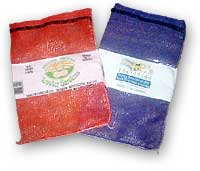
Pond filter intake cover
If you have a small garden pond with a filter and pump, a mesh bag over they intake will keep leaves, worms, and minnows out of the filter.
Wash rocks
If you have to clean decorative rocks or gravel, a mesh bag can allow you to spray a hose at the rocks without scattering them.
Big scouring pad
Fill a mesh bag with cotton rags and use as a scouring pad for a boat hull, RV, wood deck, or house exterior.
Recycling container, especially for
- aluminum cans
- glass
- tin cans
- As dust rags
- In paint preparation, to remove steel wool fibers or wood dust
Eric Wolfram, whence I stole the images here, lists several uses, including:
- Giving away at farmer's market
- Holding batteries, cables, and other electronic gear
- Carrying loose change to the bank
- Beach bag
Apparently birds get their feet caught in the modern mesh bags. Make a cube out of hardware cloth (wide-mesh heavy gauge screen) instead.
Air Clamp
Some objects that need to be clamped together for gluing cannot stand the stress of a regular clamp. You can combine a mesh bag with something like a plastic bread bag, garbage bag, or folded over piece of plastic sheeting, depending on the size, shape and strength of the objects, to make a clamp to glue them together.
- Glue the objects together
- Put the objects inside a mesh bag
- Put the mesh bag inside your air-tight container bag
- Use an aquarium air pump (or preferably something stronger) to take the air out of the bag
- Depending on the pump you have, you may either seal the bag or let it continue to try evacuating the bag.
Monday, July 30, 2007
What To Do With Old Toothbrushes
A toothbrush should be changed every three months, we're told. But what should be done with the old ones? Throwing them away seems awfully wasteful to me, so I keep them around and inevitably find uses for them.
One nice feature of the humble toothbrush is that the plastic handle can be broken, either to remove the head to use just the handle, or to make the handle shorter. With gentle pressure and even low heat, the handle can also be bent into a more convenient shape. The bristles can be trimmed to form a stiffer brush or even removed entirely.
Break the handle to about 3" and use as a fingernail cleaner.
Hang in the shower for scrubbing nails and feet. Make sure to clean (and disinfect) it between uses, or various nastiness can grow on it.
If the bristles are cut off, a toothbrush can be filed down with concrete and sandpaper to a surprisingly sharp point or blade, to make an awl or a scraping tool. An old toothbrush can really come in handy in a variety of settings:
In the garage:
- General cleaner
- Clean grease, oil and tar from car parts
- Clean dirt from garden tools and apply used motor oil as protectant
- Clean rusty items
- Car detailing: either inside or out
- Bike chain and gear cleaner
- Clean power tools such as jigsaws and Sawzalls™
- Brush the dust and debris from shop vacuum cleaners
- Use as applicator for pipe thread sealant
- Spread wood glue
- Glue sand to bristles, use as wire brush
- Break and bend the handle away from the bristles to better scrub permanent coffee filters or the coffee filter basket
- Use with baking soda for general cleaning, and also the grooves in a George Foreman grill
- Clean fruits and vegetables from the garden or grocery
- Painting and paint preparation
- Ceiling fan duster
- Laundry stain scrubber
- Grout scrubber
- Doggy toothbrush
- Handle for steel wool, cotton ball, cloth
Cleaning combs and brushes, bottles, jewelry, shoes, sliding door tracks, toys, window crevices, screens, toilets, faucets, etc. [using different brushes, obviously]. Use as an eyebrow brush.
Saturday, July 28, 2007
What To Do With Used Motor Oil
[Originally posted 20070722, updated 20070728 with orst.edu link]
Most places have laws about what you can do with used motor oil, such as mandating that it be recyeled* by a licensed facility. In fact, while writing this it was initially difficult to find any information on used motor oil other than pleas to recyele it. Used motor oil is a known carcinogen, so wear gloves and don't eat it.
A lot of the pages on the net that talk about used motor oil take the amount of oil bought and subtract the amount recycled, concluding that this amount is dumped down storm sewers or into lakes and streams. But the thing is, most people don't live near a lake or a stream, and very few people would actually dump used motor oil down the storm sewer, much less their own drain. At least, not twice.
So what do people do with used motor oil if they don't recyele it?
* I have left the spelling as "recyeled" to allow searchers to find this post by excluding the correctly spelled word.
† ← I've never tried these, but they should be interesting
Most places have laws about what you can do with used motor oil, such as mandating that it be recyeled* by a licensed facility. In fact, while writing this it was initially difficult to find any information on used motor oil other than pleas to recyele it. Used motor oil is a known carcinogen, so wear gloves and don't eat it.
A lot of the pages on the net that talk about used motor oil take the amount of oil bought and subtract the amount recycled, concluding that this amount is dumped down storm sewers or into lakes and streams. But the thing is, most people don't live near a lake or a stream, and very few people would actually dump used motor oil down the storm sewer, much less their own drain. At least, not twice.
So what do people do with used motor oil if they don't recyele it?
- Paint the bottom of wooden posts, or anything else that will be in ground contact. If you're really serious, heat the oil to above the boiling point for water and immerse your object in it. The water in the object will boil away, to be replaced by oil and contaminants. Oiled wooden fence posts that are mostly or entirely encased in concrete will not harm the environment. Don't use such posts in standing water or marsh, because the oil will leech into the water.
[Update: I found this research report from Donald J. Miller of Oregon State University, Service Life of Treated and Untreated Fence Posts: 1985 Post-Farm Report. "Post-Farm" refers to a farm full of posts, not a report after the farm.
He recommends used motor oil or crankcase oil only as a carrier for creosote, presumably because the oil only increases the useful life of posts by a short amount of time compared to its toxicity (and tendency to soften untreated wood). Using oil to carry creosote proved among the most effective treatments. In a residential or non-farm application, applied to already treated wood, plain appears to help a lot. /Update 20070728] - Soak hard-to-burn things like damp wood before lighting (don't breathe the smoke)
- Paint concrete (again, not for aquatic use).
- Paint concrete forms so they can be removed more easily taken off and reused
- Paint a brick foundation, especially the chalky mortar as a way to postpone tuck pointing. This iwill make your eventual tuck pointing job more difficult, since the new mortar will not stick as well with the oil present.
- Before paving asphalt (or asphalt over concrete), apply a coat of motor oil and allow to soak in overnight (unless rain is expected).
- Mix with staining colorants, or with old oil-based wood stain or paint. A lot of times there are things that need to be painted that will never show -- you're just painting them to protect them (why else use an oil-based paint?). So combine your leftover stain, paint, varnish, and used motor oil in a paint can and mix well. It probably won't stick to metal, but will last a long time on wood, concrete, or stone. For an effective finish, apply several coats until it is no longer absorbed.
- Use as chain saw chain oil (a very good use, but watch the splatter)
- Lubricate a bicycle chain (this is not optimal, because the thick oil tends to collect dirt)
- Clean rusty metal (paired with an abrasive such as steel wool)
- Coat outdoor tools such as axes, shovels, and clippers to keep them from rusting
- Clean road tar off vehicles (take care not to mar finish)
- Clean old engines such as on lawnmowers
- Lubricate hinges, latches, and other rough exterior hardware
- Coat nails to make them drive easier and stay rust-free
- Mix in 1 part oil with 20 parts diesel fuel and drive around †
- Oil leather (makes a dull, unattractive finish, but functions well) (do not used next to skin)
- There is a patented process for cooking used rubber tires with used motor oil, producing a variety of hydrocarbons and chemicals.
- Another (patented) process purifies used oil with acetone and ketone
- Use a centrifuge to separate impurities †
- Burn in an oil heater designed for used oil†
- Burn it in an oil lamp†
- Spread it on the ground to inhibit dust or weed growth, as this makes a nasty runoff when it eventually rains.
- Ingest it or let it contact your eyes or other such areas.
- Dump it down the drain, as this will clog your drain and mess up the sewer system
- Put it in a landfill, as this is dangerous and harmful in about six ways.
* I have left the spelling as "recyeled" to allow searchers to find this post by excluding the correctly spelled word.
† ← I've never tried these, but they should be interesting
Wednesday, July 25, 2007
How to Pull Cables with String
The knot to use is called a "stitch", and it is the same technique used in data centers to secure bunches of cables without all of that Velcro mess.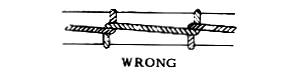
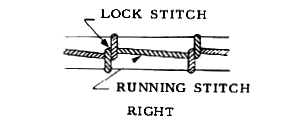
Either the "Right" or "Wrong" style will work, and I describe the "Wrong" method below. This works for Ethernet cable, Romex®, and similar cabling. It's a great technique to use with fish tape, the metallic band on a reel used to fish inside of walls.
For fish tape, you typically fish the tape from where you want to go to where the cable is. Attach the string to the hole in the end of the tape. The other end of the string gets the procedure above.
Sometimes your intended run is such that you can't get yourself or the fish tape reel to the destination. If you have an open space between two holes, sometimes the fish tape flops around. In those cases, attach the string to the fish tape before fishing it through, so that you can control the tape a bit with tension on the string. You will then have string all the way through the run.
I've used this knot (doubled) for connecting two ropes, since other knots form a point of weakness and this one doesn't (when doubled). Knot the loose ends in a square knot rather than with tape.
Either the "Right" or "Wrong" style will work, and I describe the "Wrong" method below. This works for Ethernet cable, Romex®, and similar cabling. It's a great technique to use with fish tape, the metallic band on a reel used to fish inside of walls.
- Make two loops in the string.
- Turn one around.
- Stick the cable through the loops.
- Pull on the string to tighten (it's OK for the loops to separate). If done properly, the harder you pull on the string, the tighter the knot gets. If done wrong ... just do it again.
- Wrap with as little electrical or duct tape as possible to secure the loose end of the string, protect your cable end, and to keep the end of the cable attached to the string so it doesn't wedge as you pull it. Too much tape will snag as you pull it through.
For fish tape, you typically fish the tape from where you want to go to where the cable is. Attach the string to the hole in the end of the tape. The other end of the string gets the procedure above.
Sometimes your intended run is such that you can't get yourself or the fish tape reel to the destination. If you have an open space between two holes, sometimes the fish tape flops around. In those cases, attach the string to the fish tape before fishing it through, so that you can control the tape a bit with tension on the string. You will then have string all the way through the run.
I've used this knot (doubled) for connecting two ropes, since other knots form a point of weakness and this one doesn't (when doubled). Knot the loose ends in a square knot rather than with tape.
What To Do With Old Wire and Cables
This is about copper cable, such as old 2-,4-,or even 50-pair telephone cable, cat-3 or cat-5 Ethernet cable, non-metallic electrical cables (Romex®), or anything similar. Whether you choose to reuse or recycle it, the stuff is getting too expensive just to throw away. This page describes how to use it for audio speaker wire, make rope from it, or even how to use it for some really environmentally awful fun.
- Copper cable can be recycled, but finding a recycler nearby who deals with it may be difficult. Luckily, Earth911.org provides a recycler locater search box.
- Use old RG58 Ethernet cables with BNC ends as speaker cables, with BNC jacks in wall plates as needed. This type of cable is designed to carry radio frequency signals, and works even better at lower audio frequencies where impedance is negligible. It's easy to use, way cheaper (if you've got it already) than doing what this guy recommends. The sound is the same.
- Old twisted-pair (Cat-3 or Cat-5) Ethernet cable works great as a source for color-coded twist ties. Leave the vinyl jacket on until use, then strip off as much as you need. Or you can cut it all up and stand it in a jar.
- Rope: braid a strand of copper cable with two strands of other cord, of either synthetic or natural fibers. This makes a rope that is stronger than the individual cords and that will never rust.
- Rope 2: Braid twisted sets of copper wire with strands of cotton or synthetic string of similar thickness, again making a rope. Use as many individual strands as you want, up to a practical limit. You can make the twisted sets of copper wire by attaching one end of a set of wires to an electric drill and the other to something fixed in place. Twist one set of wires clockwise, the other counterclockwise. This can be done in stages without cutting the wires. Twist each section the same amount and as tightly as desired, but avoid knotting. Braid the three (or more) pieces of cable or cord together, taking care to balance the twisting directions (so the resulting cable will tend to kink less).
- Romex makes a nice pipe hanger for plumbing work, since it's flexible but stays in shape. The individual strands (solid wire only) also make excellent heavy-duty twist ties.
- PVC-coated copper makes a pretty, multicolored flame when it burns on a campfire. The smoke is toxic, of course, and so not really good for the air, but still, it's pretty.
Tuesday, July 24, 2007
What To Do With Old Wooden Pallets

If you ever take a bulk delivery on materials, you may find yourself with several wooden pallets, and not know what to do with them beside burning them or begging the garbage man to take them away. Wikipedia suggests they can be used for a number of really clever things. Here are some not-so-clever but very easily completed projects for anyone with a hammer and nails. All of these work very well because wooden pallets are made not to come apart.
Note: most inexpensive pallets are made from untreated pine or other softwood, which will ensure that the part of the pallet exposed to the ground will begin to rot soon. Rarely, you may find a pallet made from treated pine. (If you burn it, don't breathe the smoke.) It will take a few years before the compost bin falls apart, which gives you plenty of time to find more pallets. Hardwood pallets may last longer, but are often subject to a deposit.
- Make a workbench
I did it a few years ago. I had to cut one of the pallets in half for some reason, but I don't remember why. I ended up using a scrap 2x4 as a support on the back, and some masonite or fiberboard as the top.
- Make a compost bin
Just nail three pallets together in a 'C', with the deck boards facing in. They don't have to be vertical, but it makes the composting part work better. Nail in a couple of diagonal supports on top if it won't stay rigid. Just face the back toward the neighbors and fill. You'll never have to burn leaves or buy fertilizer again.
(Image from the National Wood Pallet & Container Association, under fair use) - Build a dog house
If you have a dog, even one that mostly lives inside, using three or four pallets you can make a nice, sturdy spot for your little wolf.- Lay a pallet on the ground
- Lean two more pallets together on top of the first one, with the bottom edges of the top two resting between two deck boards.
- Nail the roof-walls together, optionally using a couple of boards to make cross-pieces at the open ends.
- Secure the roof-walls to the bottom, either by nailing them directly together or by some means left to your creativity to devise
- Cover it with plywood, shingles, or any other weatherproof material so that Fido has a spot out of the rain and sun and off the ground.
- Throw in a piece of old carpet or welcome mat for that homey touch.
Monday, July 23, 2007
Troublesome Filenames
smith: In my public_html directory there are subdirectories called "~backup" and "~smith". "Backup" is the name we use for file archival of old work. When I cd to them I'm taken to some home directory. What's going on?
Other inconvenient filenames can require a "\" (backslash) to quote characters that are special to the shell, such as "-" (hyphen), "~" (tilde), " " (space). The newer shells offering command-line completion will automatically quote the characters for you.
Advanced users may wish to apply the stream editor sed to the problem.
For a list of names of punctuation marks, I recommend the Wikipedia entry.
me: That looked funny at first, but I think it's ok.
A ~ (tilde) character is shell-ese for a home directory, either your own by itself or that of a given user with "~username". So when you entered "cd ~smith", it actually took you to your home directory. The /public_html/~smith thing is a real directory with a tilde as the first character of the name. You can create a directory with that name by typing
mkdir public_html/~smithThe tilde is only interpreted as a home directory when it's the first character of a directory name, and only by csh/tcsh/zsh/ksh. Shell scripts are typically interpreted by the Bourne shell (/bin/sh), which doesn't know what "~smith" means, so sometimes shell scripts will create files named like that.
Entering
cd ~smith/public_html/~smithtook me to a directory that didn't look like your home directory. I renamed public_html/~backup to public_html/backup and public_html/~smith to public_html/smith.
There are other misbehaving filenames. Usually they come about the same way the "public_html/~smith did: UNIX file systems allows filenames to contain characters that are special to some command interpreters. For example, a mistaken cut-and-paste operation can generate several spurious commands, perhaps creating files with random names. Misbehaved filenames may make it hard to work with files, even in the newer shell programs.
For instance, files beginning with a hyphen ("-") will confound some commands. If you have a file named "-h" and try to do anything to it, the usual commands such as mv, cp, or rm will interpret the name as a command line switch and tell you you're typing the command incorrectly:
~/temp me@server 8:48> ls -lThe solution is to specify a path name for the file, either an absolute path as in /usr/local/bin/--badfile, or a relative path such as "./" (dot forward-slash, meaning the current directory).
total 0
-rw-r--r-- 1 me mygroup 0 Feb 20 08:46 --help
-rw-r--r-- 1 me mygroup 0 Feb 20 08:46 -h
~/temp me@server 8:48> rm -h
rm: illegal option -- h
usage: rm [-fiRr] file ...
zsh: exit 2 rm -h
~/temp me@server 8:48> mv -h goodname
mv: illegal option -- h
mv: Insufficient arguments (1)
Usage: mv [-f] [-i] f1 f2
mv [-f] [-i] f1 ... fn d1
mv [-f] [-i] d1 d2
zsh: exit 2 mv -h goodname
~/temp me@server 8:48> rm ./-h
~/temp me@server 8:48> mv ./--help goodname
~/temp me@server 8:48> ls -l
     total 0
     -rw-r--r--   1 me    mygroup        0 Feb 20 08:46 goodname
Other inconvenient filenames can require a "\" (backslash) to quote characters that are special to the shell, such as "-" (hyphen), "~" (tilde), " " (space). The newer shells offering command-line completion will automatically quote the characters for you.
Advanced users may wish to apply the stream editor sed to the problem.
For a list of names of punctuation marks, I recommend the Wikipedia entry.
Sunday, July 15, 2007
Six Flags St. Louis
We went to Six Flags St. Louis on a 90°F July Sunday.
We got there at 9:30am, though the park opens at 10:30. There were about 20 cars ahead of us at the gate, and by the time they opened the gate to let us in the parking lot, there were at least 100 cars waiting. We parked, showed our Internet tickets to the cashier, and then waited until 10:15 at the entrance turnstyles. We made our way toward the first ride of the day, only to be stopped by park security. They held everyone back from the attractions until 10:30.
My take: either open, or don't open. Don't do it halfway. I guess it's their business, though.
While waiting for security to stop their tyranny and allow us to ride the rides, we developed a plan. Security had deputized a couple of pre-teen kids, signified with adhesive label badges. We decided that unless word came soon that we could go into the rest of the park, we would point to the ground and say "Look! A toy!", dash past the distracted kids, and quickly take over the park, allowing us to be the first to ride the rides that day. While demponstrating that move, I didn't realize that an older boy was watching me. He looked for the toy. This could work!
But while we were still laughing at the older kid for actually falling for the trick, the guards relented from their oppression, and we dashed to the first ride.
Mr. Freeze: thrilling, but too short. On the other hand, I could sit and watch the takeoff and landing for hours. We rode it twice.
Batman: Good coaster, but even though you're upside down a lot, there's no weightlessness. The line is always too long.
Ninja: Great coaster. No line, so we went through about 6 times. We found it physically tiring, because this older coaster beats you up. Still, there's lots of air time.
Screamin' Eagle: I was surprised at how much I liked this 30+ year old wooden relic. Once the biggest wooden coaster in the world, this thing is still great. The first time though, a dad was telling his 6- or 7-year-old that the boy was brave enough to ride the Screamin' Eagle. The boy wasn't sure, and whined about Mom not riding. Dad encouraged, saying "You've already been on Ninja and Batman, you can do this one!" I said if he'd been on those, this one would be a piece of cake. I turned to my own son and whispered that I was a big liar, that this was going to kill him. Buuaaa-haah-haah. Especially at the back, you get a lot of floating air time, and the 4000-foot ride is long enough to enjoy. Since it's old, it's not as popular as the newer ones, so we got to go through several times.
(The dad and kid behind us both loved it.)
The Boss: line too long, didn't ride it. Really long wooden coaster, people said it was pretty good.
Tidal Wave: This is a short little water-car ride, the entire object of which is to make a big splash. Yes, you get wet, no matter where you sit. To get really soaked, stand on the bridge overlooking the car as it splashes into the tidal pool. I wrapped my wallet in a little park map, and it stayed dry in my pocket. Wish I'd brought a Zip-lock baggie.
A word about prices: they suck. At Six Flags, everything costs way too much. $7.50 for a turkey thigh seemed like a bargain compared to the $3 bottled water, the $10 32oz sports bottle, and the other overpriced fare. And except for the turkey thigh, which I recommend, the rest of the food was crappy.
We took a bit of a tour of their water park area. Lines, crowds, and everything is $10. Rent an inner tube (required for some attractions) for $10, a locker for $10. At Holiday World / Splashin' Safari in Santa Claus, Indiana, the inner tubes are free.
At Holiday World, the rides are maintained better, the staff is friendlier, and there is free soda all day, every day. It makes for a nicer experience.
Overall, Six Flags has some nice roller coasters, but Holiday World does, too. Given the overall suckiness of Six Flags and their attitude about grabbing every last dime you have, I'll go to Holiday World next time.
(No one paid me to write this, and I'm not affiliated with any theme park or similar competitor)
Subscribe to:
Posts (Atom)